
| Rating | Image | Product | Details | |
|---|---|---|---|---|
The Winner

|
|
Ryobi P108 |
|
CHECK PRICE |
The Runner up

|
|
Ryobi P107 |
|
CHECK PRICE |
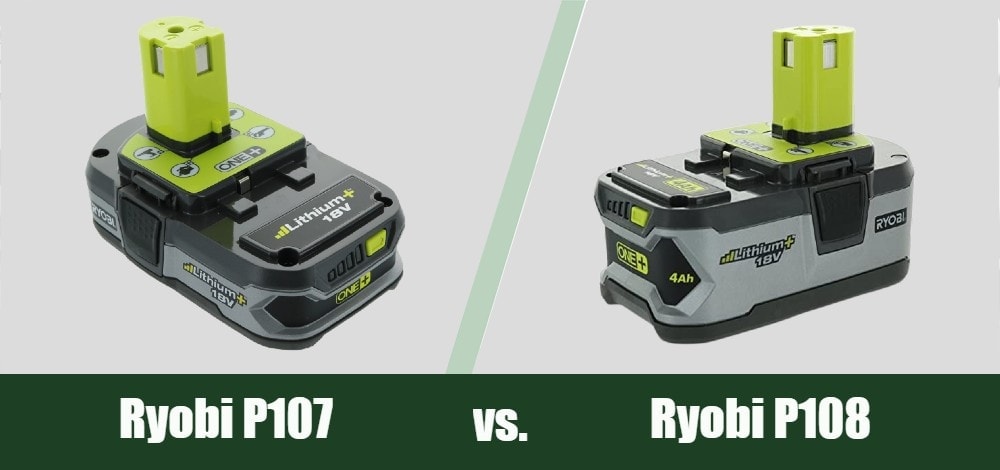
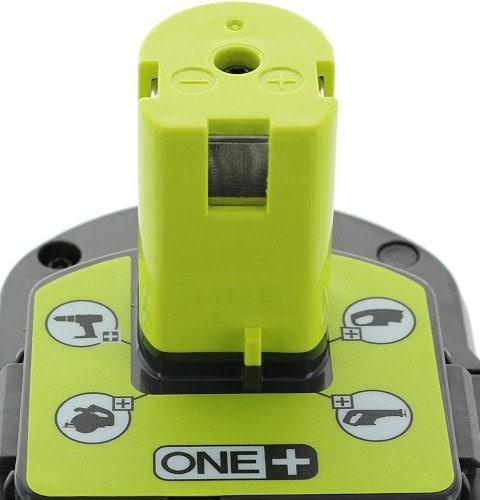
Ryobi’s P108 is the lithium-ion battery the entire Ryobi One+ world is waiting for. It was the first to deliver significantly more power than the old P100, Ryobi’s old standard nickel-cadmium battery. It’s a little heavier than the other models, including the P107, and a little more expensive. Is it better than the P107? If you need extra power for a tool like an impact wrench or a reciprocating saw, the P108 is ideal. If you want to hang shelving, you can probably save a few bucks and go with the P107 without seeing a performance drop.
What’s the difference between them?
Performance – Edge: P108
Until the P108, Ryobi’s One+ lithium-ion batteries had struggled to provide the same power as the old P100 nickel-cadmium battery. The P108 blew down that barrier by bringing twice the power of the old batteries. This makes it ideal for demanding jobs and big tools and gives it a performance edge over the P107.
Price – Slight Edge: P107
Considering the difference in power, you’d expect the price difference to be much more significant. Costs for lithium-ion batteries have dropped considerably in recent years, and high-end batteries are more affordable. You don’t need to spend twice to get double the power; just a little more will do.
Durability – Big Edge: P108
The Ryobi P107 isn’t just more powerful, it can hold a charge significantly longer than the smaller models of the Ryobi One+ battery universe. In field tests, the P108 can drill more than twice the number of holes you can drill with the P107. Since you don’t have to charge the battery often, it will last longer.
Design – Slight Edge: P107
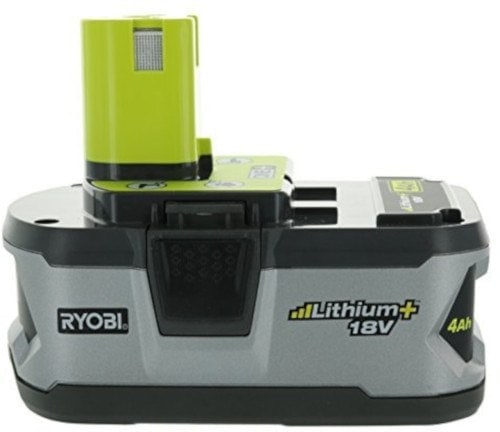
The P107 is underpowered compared to the P108, but is smaller and lighter. If you’re working in a tight space for several hours, the lighter battery makes your tool easier to handle and maneuver. It also means that over a long day of working, you’ll be less tired using the P107 than the P108.
Quick Rundown of Ryobi P107:
- FUEL GAUGE: Know how much charge you have left in the battery with the LED lighting system on the front, activated with a button
- COMPACT: Power your tools with less weight than the bulky 4Ah batteries, allowing you to physically work for longer and bring your...
- ONE+ COMPATIBLE: These batteries work with many tools in Ryobi’s One+ lineup. That’s more than 50 tools this is compatible with...
As a suitable stepping stone to the big power of the P108, the P107 is a marked improvement over Ryobi’s old nickel-cadmium batteries and a valuable part of the Ryobi One+ system. It holds its charge for a long time and is smaller and cheaper than the P108.
- Holds power better than nickel-cadmium
- More affordable
- Smaller and lighter
- Not as powerful
- Doesn’t hold power nearly as long as the P108
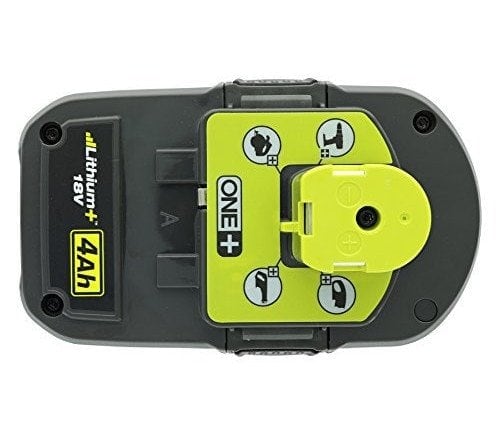
Quick Rundown of Ryobi P108:

- ONE+ COMPATIBLE: Works with any power tool from the Ryobi One+ System. Use this on your cordless routers, circular saws, reciprocating...
- MORE POWER: This extra large battery holds over 4 times more power than the other, smaller models
- QUICK CHARGE: The P108 can be fully charged in as little as one hour
With groundbreaking power and a long-lasting charge, the P108 is a must-have for anyone with heavy-duty work or big tools to power. It’s a big battery that costs a little more, but the additional power is worth the price.
- Much more powerful
- Lasts much longer
- Bigger and heavier
- More expensive
 Final Verdict
 Final Verdict
Both of these batteries are vital parts of Ryobi’s One+ universe. The Ryobi P108 is a powerhouse that delivers twice the power of Ryobi’s old nickel-cadmium batteries with a longer lifespan. It’s also bigger and more expensive than the P107. If you need more power for heavy-duty jobs or massive tools, you should have at least one P108 in your inventory. If you’re just looking for a basic battery, the P107 will probably be more suitable for you.